OSMA Continues Development of NASGRO® Software for Fitness-for-Service Analyses of Ground-Based Pressure Systems
Over the past 10 years, the Office of Safety and Mission Assurance (OSMA) Pressure Systems program facilitated a broader use of the NASGRO® software for analyzing and sustaining pressure systems.
(Note: Earlier program accomplishments and efforts were reviewed in the Aug. 7, 2020, article, “ OSMA Promotes Development of NASGRO® Software for Use on Ground-Based Pressure Systems.”)
The agency has a long history with this software, particularly for aerospace applications. By expanding the capabilities of NASGRO to incorporate Fitness-For-Service (FFS) of ground-based pressure systems, NASA centers can take advantage of access to perpetual, royalty-free NASGRO licenses that realize a significant cost savings in agencywide software expenses.
Background
NASA has used NASGRO agencywide as the primary fatigue and fracture analysis software for space flight hardware for more than 30 years. These state-of-the art software capabilities are available royalty-free to the NASA pressure systems community with enhancements specifically tailored to ground-based pressure systems.
The NASGRO fracture mechanics and fatigue crack growth analysis software is a general-purpose suite of analysis modules used to perform structural integrity analyses and lifetime predictions for a wide range of structures and mechanical components in many industries around the world. Its initial development began at NASA Johnson Space Center in the 1980s for fracture control of the Space Shuttle. In the 1990s, NASGRO subsequently grew into a specialized engineering software package used to analyze aging aircraft structural integrity. Beginning in 2000, Southwest Research Institute® (SwRI®) took over industrial distribution and software support.1
While the underlying fracture mechanics and fatigue crack growth analysis technology contained in NASGRO is generally applicable for the analysis of cracks in any metallic structure, the historical focus of the feature developments in the NASGRO software had been on aerospace structural applications. More recently, incremental enhancements were added to perform fitness-for-service analyses of safety-critical ground-based steel pressure vessels and other non-flight structures using approaches contained in the American Petroleum Institute (API) and American Society of Mechanical Engineers (ASME) standards and codes. These efforts facilitate the broader use of NASGRO for the analysis and sustainment of ground-based pressure systems and focus on employing the well-known Failure Assessment Diagram (FAD) as a key means of presenting failure criteria and assessing FFS.
Recent Efforts Expand NASGRO for Pressure Systems Analyses
The NASA Pressure Systems program added key stress intensity factor solutions to NASGRO for common pressure vessel geometries using one- and two-dimensional (univariant and bivariant) Weight Function (WF) technology. These solutions accommodate nonlinear stress distributions and residual stresses for their use in the FAD. These new NASGRO WF solutions include the capability to analyze internal and external circumferential surface cracks in pressurized cylinders, internal and external surface cracks in pressurized spheres, and corner cracks at pressure vessel nozzles.
Material property data are key to performing structural integrity analyses; however, because of NASGRO’s roots in the aerospace industry, the NASGRO material property database has been lacking in properties applicable to ground-based steel pressure vessels. The NASA Pressure Systems program incorporated a number of sets of material data in NASGRO for pressure vessel steels and implemented these in formats consistent with API and ASME standards and codes.
Key new materials were added to the NASGRO fatigue crack growth database in tabular form for Layered Pressure Vessel (LPV) steels and weldments obtained from testing performed during the NASA LPV Risk Mitigation Project conducted by Marshall Space Flight Center. API 579 and the ASME code provide fatigue crack growth models using the Paris equation for steels. These have now been incorporated into the NASGRO material database as one-dimensional and two-dimensional tabular data sets. In addition, the capability to compute and use lower bound API 579 and ASME fracture toughness values has been added as an option for the analyst to use when performing an analysis.
The NASFAD module in NASGRO provides the capability to use the FAD to assess the criticality of crack-like flaws. Receiving incremental enhancements over the years, NASFAD is used to perform fracture assessments given an assumed or detected crack size, material properties, and applied stresses. The principle result of the analysis is a determination of whether or not the crack is in the “safe” area of the FAD by computing assessment points and graphically comparing them to the failure assessment line. There is no crack growth performed by the NASFAD module. However, NASFAD contains options to compute a critical crack size and a failure stress using the FAD criterion. These new stress intensity factor solutions were implemented in the NASFAD module.
A key goal of the program is to enable pressure system engineers using NASGRO to perform fracture assessments consistent with API 579 requirements and assumptions. The material property data addition mentioned previously facilitates that effort. In addition, NASGRO now has a much easier way for the analyst to select among the many possible Weld Residual Stress (WRS) polynomial equations listed in API 579. NASGRO previously required an analyst to manually enter the coefficients of the API 579 polynomials — now the user simply selects the desired WRS polynomial from a menu in the NASGRO graphical user interface. This is much quicker and reduces possible input errors. It is also possible to display a plot of the WRS distribution.
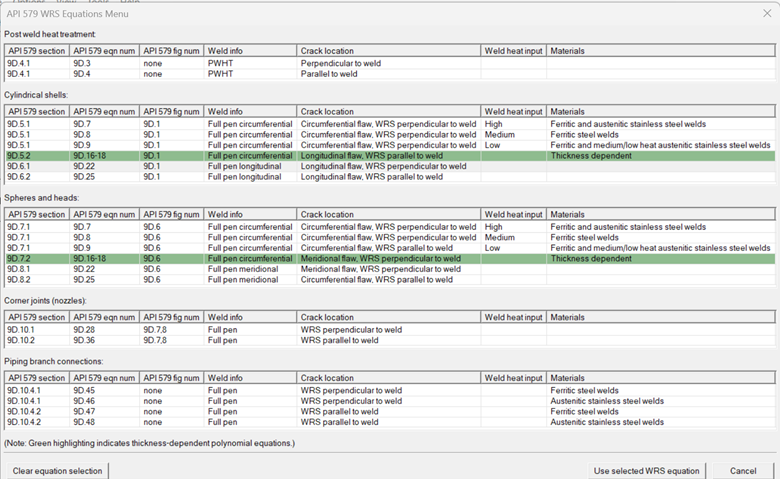
Figure 1: API 579 Weld Residual Stress Equation List
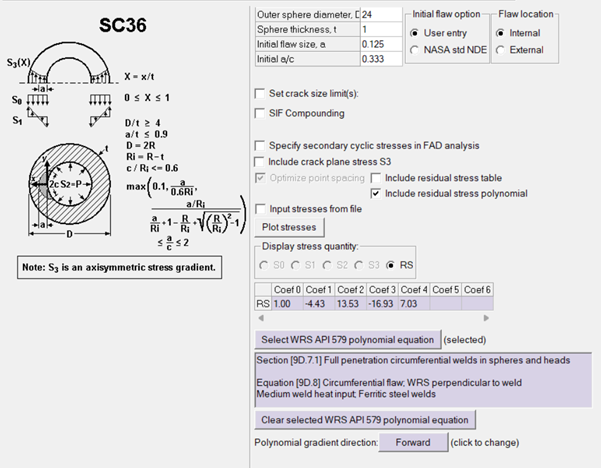
Figure 2: Univariant weight function K solution for a surface crack in a hollow sphere and plot of API 579 WRS distribution
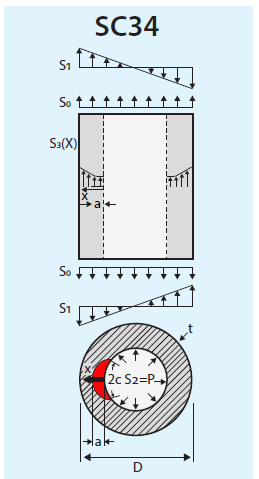
Figure 3 Univariant weight function K solution for a surface crack in a hollow cylinder
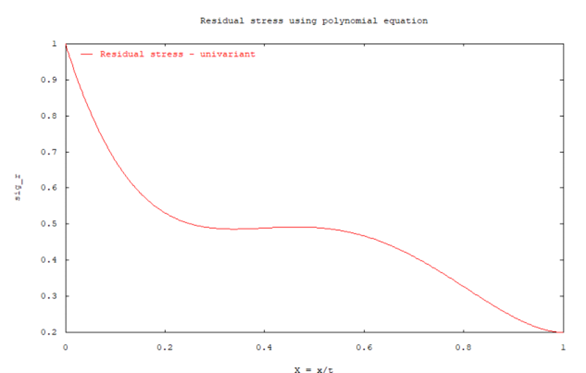
Figure 4: Residual stress using polynomial equation
During a crack growth analysis, Embedded Cracks (EC) and Surface Cracks (SC) may grow stably and transition to another shape, such as a Through Crack. While NASGRO has default criteria for such transitions, they differ from API 579. These criteria are referred to as “recharacterization” criteria in API 579 and are more conservative than the NASGRO defaults. In order to enable pressure system engineers to utilize the more conservative API 579 transition criteria, NASGRO now provides an option to select the API 579 EC and SC transition (recharacterization) criteria.
Recently, NASA has used the NASGRO software to perform FFS analyses for a number of pressure system applications. These include a surface crack in the outer layer of an LPV, a corner crack in a 2-inch diameter nozzle attached to a 2.635-inch-thick vessel wall, an internal circumferential surface crack in an 8.625-inch diameter steel pipe accounting for weld residual stresses, and an analysis of an embedded elliptical crack in a pressurized sphere meridional weld, including weld residual stresses.
“The NASGRO software is used in support of critical ground support equipment to perform assessments of crack-like flaws in piping and pressure vessels to inform the development of in-service inspection programs, and to prove safe continued use,” said Timothy D. Smith, deputy Pressure Systems manager at Kennedy Space Center.
Enhancing NASGRO software is a continuous, ongoing process. The milestones achieved over the past decade have put in place the technology required to substantiate the integrity of NASA pressure systems through a cost-effective, standardized software framework with long-term support and maintenance.
Reference
[1] SwRI® manages the development, support and distribution of the NASGRO fatigue and fracture mechanics analysis software. Since 2000, SwRI has had this responsibility as manager of the NASGRO Consortium under the terms of a Space Act Agreement first signed between the NASA Johnson Space Center (JSC) and SwRI in 2000. This Space Act Agreement grants SwRI exclusive rights to develop, market, and license NASGRO on a commercial basis, and SwRI owns the copyright to NASGRO. NASA retains a royalty-free license to use NASGRO for NASA purposes, including use by NASA contractors on NASA projects. The NASGRO development team consists of SwRI, NASA-JSC and Amentum (Houston), and is the sole provider of engineering services that are continuing the development and enhancement of NASGRO (www.nasgro.swri.org).