Introducing BioSTAR: NASA’s Bioburden and Sampling Tool for Assessing Risk
The first release of NASA’s BioSTAR tool is here — and it’s ready to make life easier for Planetary Protection engineers across the agency!
What is BioSTAR? BioSTAR is an interactive, web-based tool that brings everything you need for estimating bioburden and building your Planetary Protection Equipment List (PPEL) together in one place.
Why BioSTAR? Prior to BioSTAR, Planetary Protection engineers estimated bioburden from samples taken of spacecraft materials by applying ad-hoc techniques that did not capture uncertainty in the sampling or recovery efficiency process in a rigorous statistical way. BioSTAR streamlines and brings consistency to bioburden assessment by turning hardware samples into rigorous statistical estimates of bioburden with quantified uncertainty, all while integrating these estimates into a PPEL.
Key BioSTAR Features:
- Automated Bioburden Estimates – Enter your sampling results and let BioSTAR calculate spore counts and densities, complete with full probability distributions and quantified uncertainty at any level of your project (Gribok, 2021).
- Built-in Recovery Efficiencies – No more manual corrections. BioSTAR includes an inventory of common sampling devices with validated recovery efficiencies (DiNicola, 2023).
- Reference Library – Access data from hardware sampled on other flight projects to help refine or add credibility to your own assessments.
- Spec-Driven Estimates – When direct sampling is not an option, BioSTAR has spore density specifications from NASA-STD 8719.27, Implementing Planetary Protection Requirements for Space Flight built in, or you can easily pull estimates from similar hardware.
- Streamlined PPEL Creation – Build your PPEL directly in BioSTAR or use the simple Excel template for import/export. Outputs are formatted and ready for risk analysis (e.g., Probabilistic Risk Assessment), project reporting or future iterations.
BioSTAR
handles the tedious number-crunching and statistics for you, so you can focus
on the science, engineering and project needs that matter most.
BioSTAR
can be accessed here and via the NASA Software Catalog.
Get Involved! This is the initial
release of BioSTAR, and we’d love your feedback! To submit feedback, ask
questions or to request access and training, please contact Mike DiNicola.
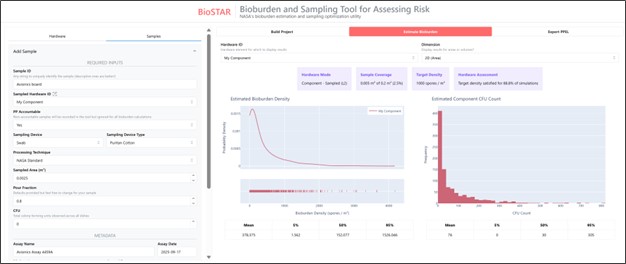
BioSTAR dashboard application. Left: Hardware component and sampling event inputs. Right: Bioburden density and spore count probability distribution outputs. The user can export this information in a PPEL format provided by the BioSTAR tool and import later for future iterations.
References:
Gribok,
Andrei, Arman Seuylemezian, and James Benardini. 2021. “Application of a
Bayesian Statistical Framework for Planetary Protection as a Means of Verifying
Low-Biomass, Zero-Inflated Test Data from Spacecraft.” Life Sciences in
Space Research 30 (August): 39–44. https://doi.org/10.1016/j.lssr.2021.05.001
DiNicola,
Michael, Arman Seuylemezian, Lisa Guan, Christine Moissl-Eichinger, Amy Baker,
and Jason Johns. 2023. “Modeling of Recovery Efficiency of Sampling Devices
Used in Planetary Protection Bioburden Estimation.” Applied and
Environmental Microbiology 89 (12). https://doi.org/10.1128/aem.00832-23